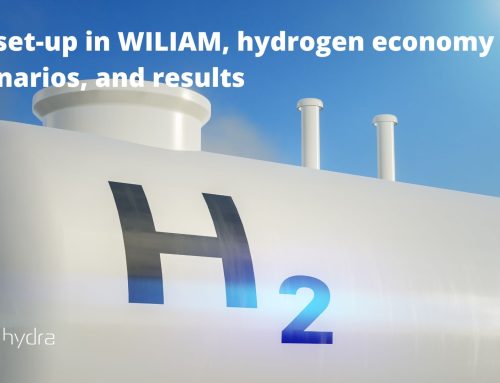


HYDRA project has been acknowledged in a recent publication of Energy Policy Journal entitled “Decarbonization potential and limits of e-fuel policies in the EU”.
The article written by University of Valladolid examines the role of e-fuels, synthetic fuels produced from renewable hydrogen and captured carbon dioxide (CO₂), in supporting the European Union’s transition to a low-carbon economy. The findings suggest that while e-fuels could help decarbonize sectors that are difficult to electrify, their widespread deployment would require substantial energy and infrastructure investments.
Using the WILIAM integrated assessment model, researchers evaluated scenarios aligned with EU climate objectives in which e-fuels supply between 5% and 15% of final energy demand by 2050. These scenarios assume an electricity system that is almost entirely free from fossil fuels.
The results indicate that large-scale e-fuel production would significantly increase electricity demand. Compared with a Green Growth pathway without e-fuels, electrification would need to rise by 49%, requiring approximately 0.7 terawatts of additional power generation capacity and 0.7 terawatts of electrolysis capacity to produce hydrogen.
The study also highlights potential constraints related to CO₂ availability. As industrial emissions decline, less carbon dioxide may be available for e-fuel production, potentially making alternative sources, such as Direct Air Capture (DAC), necessary.
Despite their strategic value, e-fuels do not appear to deliver substantial additional reductions in primary energy consumption or greenhouse gas emissions compared with a scenario focused on direct electrification. According to the authors, this is due to efficiency losses along the e-fuel production chain, as well as indirect effects such as increased electricity demand, greater pressure on renewable energy resources, and energy curtailment.
The researchers conclude that e-fuels should be deployed selectively, particularly in sectors where direct electrification is not technically or economically feasible. To maximize their contribution to climate goals, their development should be supported by strong sustainability criteria, integrated energy system planning, and demand-management measures.
Overall, the study suggests that e-fuels can play an important role in Europe’s energy transition, but they are unlikely to be a standalone solution. Their effectiveness will depend on how they are integrated into a broader decarbonization strategy based on renewable energy, energy efficiency, and reduced energy demand.